How to Memorize Vocabulary Fast and Remember It
Memorize vocabulary faster with active recall, spaced review, context, and targeted mnemonics that support long-term retention.
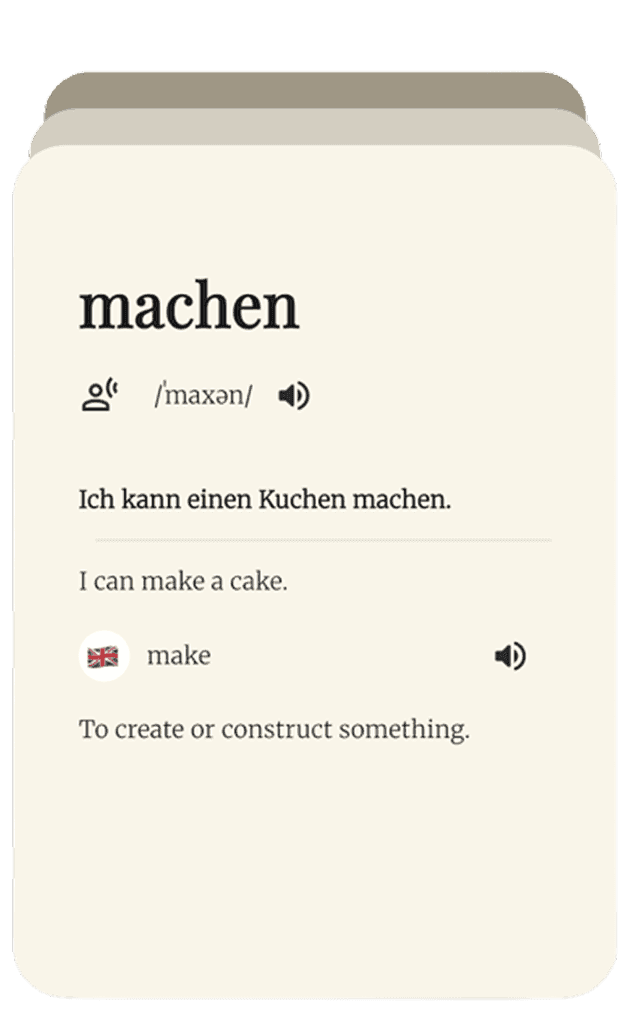
TL;DR — The fastest reliable way to memorize vocabulary is not rereading. Use active recall, space your reviews over time, attach each word to a useful context, and use mnemonics only for words that keep slipping. Fast progress means words still available next week, not words recognised for one evening.
What is the fastest evidence-based way to memorize vocabulary?
Start by trying to retrieve the answer before you see it. This is active recall: look at a meaning, image, or sentence prompt, then say or write the target word from memory. If you cannot recall it, check the answer, correct it, and try again later.
A major review of study techniques found practice testing and distributed practice among the highest-utility methods, while rereading and highlighting had much lower utility for durable learning. See Improving Students’ Learning With Effective Learning Techniques.
That does not mean rereading is useless. Read an example sentence to understand a new word, then close it and retrieve the word. Understanding supplies the meaning; retrieval trains access to it.
| Method | Best use | Main limitation |
|---|---|---|
| Active recall | Making words retrievable | Feels harder than rereading |
| Spaced review | Keeping words long-term | Needs a repeatable schedule |
| Context sentences | Learning usage and collocations | Must stay short and clear |
| Mnemonics | Repairing stubborn words | Not needed for every word |
Why does spacing help words stay in memory?
A memory becomes more useful when you retrieve it after some forgetting has begun. Reviews separated across time are generally more durable than massing the same reviews into one session. A meta-analysis of distributed practice found a robust advantage for spacing over massed practice across learning conditions: Distributed practice in verbal recall tasks.
In practical terms, avoid doing ten identical reviews in one sitting. Learn a word, test it later that day, then revisit it on later days. The exact interval does not need to be perfect; what matters is returning before the word disappears completely.
Spaced repetition makes this manageable by scheduling reviews from your answers instead of relying on a long, static list.
How do I learn a word in context without making study slow?
Use one short, useful sentence. A sentence should show what the word means and how it behaves, but it does not need to be literary.
For example:
- Bare pair: rápido = fast
- Context: El tren llega rápido. — The train arrives quickly.
- Retrieval prompt: “The train arrives ___.”
The context gives you meaning, word order, and a likely situation for reuse. After you answer, change the prompt slightly: “Is the train slow?” or “How does the train arrive?” Small variations make the word less dependent on one memorised sentence.
Keep your examples personally relevant. If you cook, travel, study, or work in the language, use those situations. Personal relevance increases the chance that you will meet and retrieve the word again.
When should I use a mnemonic?
Use a mnemonic when normal retrieval and spaced review have failed several times. The keyword method links the sound of a new word to a memorable image or phrase. For Spanish pato (duck), you might picture a duck sitting in a cooking pot.
Research reviews find that keyword mnemonics can support foreign-language vocabulary learning, particularly for difficult new form-meaning pairs. They work best as an extra hook, not as your entire study system. See The keyword method and foreign language vocabulary learning.
Make the image vivid, then return to ordinary retrieval. If the mnemonic is more memorable than the target word, simplify it.
How many new words should I learn each day?
Choose a number that leaves room for reviews. There is no universal daily quota because word difficulty, available time, and your existing review load vary. A sustainable plan beats an impressive-looking number.
Try this 15-minute routine:
- Add a small set of useful words with examples.
- Test yourself before revealing each answer.
- Mark difficult words for another review later.
- Make one short spoken or written sentence from two new words.
- Finish older reviews before adding more new words.
If your review queue keeps growing, reduce new words temporarily. Retention is the goal; increasing the queue is not.
How can I tell whether I really know a word?
Recognition is not enough. Test three levels:
- Can you recognise the word in a sentence?
- Can you recall its meaning from a prompt?
- Can you use it in a new sentence without copying one?
A word becomes useful when you can retrieve it in a slightly new situation. For longer-term planning, pair this routine with how many words you need to be fluent: focus on words that support the conversations and content you actually want to handle.
Key takeaways
- Retrieve words; do not only reread them.
- Space reviews over days and weeks.
- Learn one clear, useful context per word.
- Use mnemonics as a repair tool for stubborn words.
- Keep new-word intake small enough to sustain reviews.
Make daily retrieval easier
Lingufy pairs curated vocabulary with example sentences, pronunciations, and on-device spaced repetition. Use it for short daily recall sessions, including when you are offline, then bring the words into your own conversations and writing.
If your study time happens during commutes or flights, see best offline vocabulary apps in 2026 for a practical offline checklist.
Frequently asked questions
- What is the fastest way to memorize vocabulary and remember it?
- Test yourself before seeing the answer, then review the word again after time has passed. Active recall creates retrieval practice, while spaced reviews make that retrieval more durable than repeating the same list in one sitting.
- How many new words should I learn each day?
- No fixed number works for everyone. Add only as many words as you can keep reviewing alongside older material; if your review queue grows faster than you can finish it, reduce new words until the habit feels sustainable.
- When should I use mnemonics for vocabulary?
- Use a mnemonic after a word has repeatedly failed normal retrieval and spaced review. A keyword image can add a helpful sound-to-meaning hook, but it works best as a targeted aid rather than a replacement for regular recall practice.
Related articles

How to Learn IELTS Vocabulary (for Band 7 and Above)
IELTS tests range and accuracy, not rare words. What to study, in what order, and how to reach Band 7 vocabulary before test day.

How Many Words Do You Need to Be Fluent?
A realistic, research-aware way to set vocabulary targets without treating one word count as a promise of fluency.